Today the Elder Scrolls is one of the most popular role-playing game series on the market. Beginning over 20 years ago, it has so far spanned five main line games, a slew of spinoffs, and an MMORPG. The games have helped to popularize large, open worlds, and has become something that many other developers strive for when creating their own games to take place in sprawling landscapes.
This article will be taking a look back at the series from its early days in the mid 90s right up to the end of 2015.
ARENA
Everything began when Bethesda released The Elder Scrolls: Arena in 1994. At first, it wasn’t the intention of the developers to even make an RPG. Their original plan was to create a game where a band of gladiators traveled from one town to the next fighting other gladiators in hopes of eventually becoming champions of the world in this rather bloody competition, hence how the name Arena came about. However, that was eventually scrapped in favor of making a first-person perspective action RPG, bringing us the game we know today, whereby pretty much everything but the name got the boot.
It was a very ambitious project. A big priority for the team was to create a large, open world that players could explore at their leisure doing quests and slaying monsters along the way. There were a few other games that attempted to present fairly expansive worlds to wander before this. For example, Might and Magic: World of Xeen was considered colossal by most people’s standards back then.
The folks at Bethesda wanted something much, much grander, though. Whether or not they’d be able to pull it off was a big question at the time. The people at Sir-Tech, who were working on Wizardry: Crusaders of the Dark Savant at the time, actually laughed at them when they found out what the team was planning with Arena. Ultimately, they did succeed, giving players the largest game world that they had ever seen.
In Arena, players were able to explore the entirety of Tamriel, as opposed to subsequent games in the series that focused on a particular province within the Empire. It was actually necessary to use fast travel in order to travel from town to town since the world was so big. The wilderness outside of any given city was created via algorithms and went on for miles and miles. While there was adventure to be had in those places, getting to the next major settlement wasn’t an option there. Players would need to hop on a horse instead.
The story was simple enough. Emperor Uriel Septim VII was banished to an alternate dimension by the battlemage Jagar Tharn who had his eye on taking over the Empire. However, his apprentice, Ria Silmane, caught wind of this and tried to go to the Elder Council to warn them of what was happening. Unfortunately for her, Jagar knew what she was trying to do and had her killed. From here, the player has several encounters with Ria’s spirit as she tries to guide them through finding all of the pieces of a shattered artifact that, once reassembled, can be used to open a portal to the alternate dimension and rescue the Emperor.

The whole time, the game was far from linear. There was no rush to go and save Uriel, and there was a great big world waiting to be explored, so what was the hurry? On top of this, there was a slew of side quests to go on. As a result, players could wander Tamriel at their leisure, soaking in the sights and sounds, helping the locals along the way without feeling rushed to go rescue the Emperor. Even many of the NPCs were created through algorithms. While many of them said the same thing, it did make the world feel much more populated, enticing players to wander around and talk to people all the more.
While Tamriel’s great outdoors tended to be procedurally generated, the dungeons of the game were handmade. Exploring these, players could see the attention to detail. These would often times be quite large and very complex, reflecting the far more elaborate dungeon designs that were the norm in games of this period.
The game even had an early sort of day / night cycle. As time passed, the sun would go down, shops in towns would close for the night, and the streets would become a dangerous place with the town folk at home safe in their beds and monsters now lurking the thoroughfares.
As exciting as all of this was, Arena did gain a reputation for being hard on newcomers. Right from the start, players were dumped in a dungeon with hardly anything in the way of equipment. They had to wander it looking for some basic loot that they could arm themselves with and make a beeline for the exit, all the while fighting rats and goblins, and sometimes more powerful enemies if they lingered too long in the labyrinth. For people new to the game, it could sometimes be a brutal system as they would get pummeled again and again, being forced to load old saves, hoping against hope that at some point they’d be able to escape that terrible place.
Over time, though, the game would become much more manageable. Once players finally got a hold of some decent gear and developed a better understanding of the game, their journey started to feel a little bit easier as some of the daunting difficulties from earlier melted away.
It didn’t take much time with Arena to see what its influences were. Pen and Paper RPGs as well as computer role-playing games such as Ultima Underworld and Legends of Valor were quite visible in Arena. These were other examples of players going into some sort of game world and having the freedom to more or less do as they pleased, or in the very least not be on the rails so much, forced to follow a very set path carved out by some designers. Bethesda tried to take the relative freedom and immersive first person perspective of these games and enhance it as players ventured throughout Tamriel.
All of this being said, Arena got off to a rocky start. Originally, the game was planned for a Christmas 1993 release but got delayed by several months. When it finally did come out, the thing had quite a few bugs still. As a result, critics were not all that impressed with what they saw. Making matters worse, only about 3,000 copies shipped in the original release. Things were not looking good for the game. Luckily, Arena got a lot of positive word of mouth, allowing it to slowly develop a cult following as the months wore on. In the end, the game managed to do quite well for itself. No one had seen such a huge, living world before in a video game, and what Bethesda did with this game started pushing people to think about RPGs a little differently and wonder about the possibilities if designers continued in this direction.
DAGGERFALL
A couple of years later, the team put out their second Elder Scrolls game, Daggerfall. Continuing what they had started in Arena, this was another very large game with a huge number of places for players to explore. However, this go around the adventure would center on the province of Daggerfall, even though when the game was in its very early stages of development the team was looking at having it take place in Morrowind instead.
Looking to build upon what they did in Arena, Bethesda added a slew of new features for Daggerfall. Magic was highly customizable with players able to create their own spells. Players could buy their own house. It was possible to become a vampire, wereboar, or werewolf. A dynamic political system was also implemented, a favorite with players. This brought about a sort of faction system whereby how players dealt with and helped one group could have an impact on how other groups would react when encountered. We also saw a change to how characters leveled as the game did away with traditional systems of purely accumulating experience and then spending points on abilities upon leveling up, and instead characters’ abilities grew stronger depending on whether or not players actually used them.
In this game, players had been sent to Daggerfall by the Emperor for a couple of reasons. First, they had to free the ghost of the dead King Lysandus, whose spirit had been shackled to this realm. Second, one had to figure out what happened to a letter sent by the Emperor to Blades spy in the region. As the story unfolded, players would see many of the inner workings of the Empire and begin to understand why the letter was so important. Depending on how one tackled the main quest, the game had six different endings, adding quite a bit of replay value. Of course, there were plenty of side quests too, so players could wander off doing their own thing in this world for quite some time while barely touching the main quest if they were so inclined.
With all of these different places to go and all of these different things to do, a lot of work had to go into making Daggerfall a reality. The result was a grueling development cycle. For example, only three of about 20 artists to contribute to the game managed to survive through the whole of the game’s creation while the rest tossed in their towels and went elsewhere.
Nonetheless, the game released on schedule in August of 1996. Again, the game was criticized for an abundance of bugs in it, but this time it was much easier for developers to address the problems via patches. That being said, this did give the team pause and got them thinking more about their development schedules and what they could do to prevent such buggy releases in the future. Despite the less than perfect release, the game once again was embraced by its players and word of mouth ensured that would be a success.
BATTLESPIRE
In 1997, Bethesda began to take a break from the mainline Elder Scrolls games and experiment a bit with a couple of spin-offs. The first of these was Battlespire, a game released under the “Elder Scrolls Adventures” banner. Originally planned as an expansion for Daggerfall, it eventually became its own standalone game.
Taking place in the Battlespire, an academy of the Empire for training battle mages to join the imperial legion, players took on the role of an apprentice who was supposed to be on their final day of training. However, it was discovered that the place had been invaded by the Daedra Mehrunes Dagon and his army. Players had to travel through the realm of Oblivion in order to fight these legions of baddies and put a stop to the daedra’s plans while also rescuing their partner who had been captured.
Compared to Arena and Daggerfall, this was a much simpler game. There were only six races to choose from: Dark Elf, Wood Elf, High Elf, Norn, Breton, and Redguard. There was no rest feature, and shops and gold were removed, necessitating players acquire items from fallen enemies and the like, also enemies didn’t respawn, nor were they randomized.
Interestingly, the game included an online multiplayer mode. Here players could either tackle the single player story in a coop environment, or go head-to-head in a two-player versus mode.
Unfortunately, the game didn’t go over well with either fans or critics, as both felt that the it lacked in scope and simply didn’t impress like Elder Scrolls I&II did.
REDGUARD
A year later, the studio went in a slightly different direction with 1998’s Redguard. This game was an action-adventure much more similar to the likes of Tomb Raider than the RPGs that had comprised the series up to this point, and was again released under the “Elder Scrolls Adventure” label.
Taking place 400 years after Arena, players followed the story of Cyrus, a Redguard who had come to the island of Stros M’Kai in search of his missing sister. The game remained non-linear like its predecessors but it was also a lot more contained with it taking place on such a small landmass.
One can actually see the beginnings of a change in design philosophy with this game that would continue with future installments of the Elder Scrolls. Up to this point, creating large amounts of the game world through algorithms had been heavily used in the series, but in a 1998 interview with series producer Todd Howard, he discussed how those games were really big, but sometimes this lead to a certain amount of samey-ness depending on what the algorithm spat out. With Redguard, he chose to create the world by hand as an attempt to move away from this. Hence the game taking place on the tiny island that it did, and the relatively small number of NPCs to interact with, as the game tried to go for a less is more approach.
 |
| If you look carefully, you can see the foreshadowing of future Elder Scrolls games in Redguard's opening. |
There was actually plans for a sequel to Redguard at one point revolving around the Eye of Argonia, but that never came to light. However, more observant players will notice a little bit of foreshadowing for the series in the game’s opening cinematic where one can see a bookshelf where tomes named The Elder Scrolls: Arena, The Elder Scrolls II: Daggerfall, The Elder Scrolls III: Morrowind, and The Elder Scrolls IV: Oblivion are sitting. Given the actual path that the main series took in the years to come, one can see that the team had been planning this stuff out well in advance.
MORROWIND
In the wake of Battlespire and Redguard, things weren’t looking good at Bethesda. Neither game managed to sell very well and the studio was facing serious financial difficulty. Being brought into Zenimax in 1999 provided the company a stay of execution, but their next game would have to be a bonafide hit if they were to survive. With that, the studio got to work on Morrowind. So dire was the situation that there were only six people working on the game initially. In a sense, Bethesda was facing a Final Fantasy moment where their next project would either make or break the company.
With that, Morrowind turned into a game where the development team took a lot more risks in what they implemented. They took an almost nihilistic mindset heading into the project, tossing all sorts of ideas at it figuring, “What’s the worst that can happen? We lose our jobs?” It was a rather extreme attitude to take, but it worked. To this day, Morrowind is one of the most unique entries in the Elder Scrolls series.
Right from a very early point in the game, players are greeted by a strange event. After creating their character, wandering around the starting village, and picking up some supplies, one will usually head into the world to see what’s out there. Assuming they took the main road, they’ll have barely walked a few steps out of the village when suddenly a wizard comes falling out of the sky right in front of them, slamming into the ground, dying instantly. This leaves players wondering what the hell just happened. You just don’t see wizards raining from the sky in RPGs, or any other genre for that matter. As players wander further and spend more time getting to know Morrowind, it becomes clear that the event is like a message from the game’s developers telling them to expect the unexpected and that this run-in with the wizard is just the tip of the iceberg for what's in store from the game.
The province of Morrowind was always regarded as a strange, exotic place by the other regions of Tamriel. From the wildlife, to the flora, to the architecture, there were countless signs that this was a very different land. Walking around the edge of town and seeing a silt strider for the first time, seeing all of the peculiar dome-shaped houses, trying to strike up conversations with the secretive, standoff-ish dark elves, the whole flavour of the game felt very different from the vast majority of other RPGs being released at the time where more often than not a European fantasy motif was employed.

All the while, the game looked quite pretty for the time. While today, some may feel that Morrowind hasn’t aged very well when run without mods, when it first came out people marveled at what was happening on-screen. The environments were filled with details, there was real-time weather effects, something you just didn’t see in 2001, when the game first came out, and glass armor was much sought after so people could just stop and oggle it in all of its green, shiny glory. About the only question players had about the visuals was, “How could such a pretty game have such an ugly citizenry?” Because character models’ faces were far from elegant back then.
Character progression built upon what was done in Daggerfall whereby skills were increased through practice, study, and training, resulting in countless players endlessly jumping down the road in order to level acrobatics, because why not? Frustratingly for some, however, dice rolls played a part in determining whether an attack would land as well, so no matter how much one trained axes, for example, if the dice weren’t cooperating, it didn’t really matter.
Adopting a similar philosophy to what they did in Redguard, the developers went for a smaller, handmade world. This was the first mainline entry in the series to do away with algorithmically created areas. Instead, the team sat down and made everything themselves. The world was still very large compared to anything else out there, but everything felt more fleshed out and like it had purpose since it was actually created by a human.
The plot of the game centers around a prophecy in Morrowind that says one day the reincarnation of Indoril Nerevar, known as “The Nerevarine”, would one day return to the land in order to defeat Dagoth Ur and his followers. Players first arrive in the province as a convicted criminal largely forced to work for the emperor and investigate this prophecy. Compared to Arena and Daggerfall, Morrowind’s story felt more fleshed out, but there were also far more side quests. The game was designed more to try and intertwine these such that players really interacted with the world and got a better sense of all the layers of intrigue and political battles going on behind the scenes among the various factions and noble houses of the province.
Factions played a very important role in the game, as there were several pitted against one another in Morrowind and because the player was an outsider, it became all the more important to win them over. Everyone refers to you as “Outlander”. You’re constantly reminded that you’re not of this part of the world, and you’re going to have to work very hard to gain the dark elves’ trust. As the player interacts with the various groups at play, it becomes apparent that Morrowind is a very complicated place.
This was the first Elder Scrolls game to get a console release, coming out for the original Xbox, and marks the series first steps toward garnering greater mainstream success, being its first multi-million seller. The game was also extremely well-received by critics, garnering very high review scores. The size of the world and the attention to detail in creating it were highly praised in reviews, and held up by fans as some of the best aspects of Morrowind.
It did so well that Morrowind got two expansions: Tribunal and Bloodmoon. Tribunal was the first of these. It took place in the walled city of Mournhold, completely cut off from the main game’s world, requiring players to be teleported to it. The expansion continued the story of the Tribunal deities as well as including some minor improvements to the game proper, such as tweaks to the journal system. Bloodmoon came next and reintroduced lycanthropy into the game, with players eagerly running off to become werewolves. It was also a larger expansion than Tribunal with quite a few more quests and adding more land to the main game with a large, tundra region to the north.
Morrowind was also the first game in the series to have its music handled by Jeremy Soule, still an up and coming composer at the time, having garnered quite a bit of attention for his work on Total Annihilation and the Icewind Dale series a short time earlier. He would stay on for future installments in the series, thus making its soundtrack one more thing that the Elder Scrolls series became known for.
Finally, the inclusion of the Morrowind Construction Set resulted in the game being heavily supported by modders, a feature that would become vital to the series going forward. With this we saw reams of user created content for the game. Whether it was armor, audio tweaks, new buildings, or entire quest lines, there was no lack of new features to come about from this editor. To this day, people still make stuff for the game, with a massive overhaul to the game’s visuals being one of the more notable additions in recent year.
THE NGAGE GAMES
In 2003 and 2004 we saw the Elder Scrolls take an unexpected turn with a trio of titles being released on the N-Gage, Nokia’s “totally side-talking” hybrid of a cell phone and handheld game console that came and went years before mobile gaming became the juggernaut that it is today.
These all came out under the moniker “The Elder Scrolls Travels” and were called Stormhold, Dawnstar, and Shadowkey, respectively. None of these games were developed internally, instead being handled by Vir2L Studios. The games allowed up to four player cooperative play as they explored surprisingly large game worlds as far as portable games went.
Unfortunately, they were heavily criticized for their lack of draw distance as objects and enemies would only appear with short notice in many instances, and the games are largely forgotten today.
OBLIVION
2006 saw the return of the main series with Oblivion, though development started in 2002 directly after the release of Morrowind.
The story takes place after the events of Morrowind and has players trying to stop a fanatical cult calling itself the Mystic Dawn from opening the gates to the realm of Oblivion. Taking place in Cyrodiil, one can see the seat of imperial power first hand. Once more, the game is huge, with tons to explore as one tries to put a stop to the cult. Narrative was a much bigger focus during development, so there was quite a lot in the way of story in Oblivion. That being said, it was set in a much more traditional European fantasy world than what we saw in Morrowind and met with mixed opinions, where some people loved it and others didn’t much care for the aesthetic.
Bethesda also implemented their Radiant AI System for the first time with Oblivion in an attempt to make NPCs behave more realistically. Often times in games, these types of characters would have fairly fixed roles like guards maintaining the peace, merchants selling their wares, or would be characters who had very specific goals to complete or assign, like a quest giver. Even if they had a lot of conversation paths when talking to them, their overall behavior was still quite rigid as they adhered to the basic role that they had been assigned. Radiant AI was created to make NPCs grow beyond this, developing their own quirks that would make them more than just the guy you sold cheese wheels to or whatever.
The end result was modest with these characters making baby steps toward becoming their own people. As much as it was hyped up, Radiant AI didn’t make a huge difference in behavior but it was a start, and maybe for the best. Developers had stories of the system working a little bit too well during testing with one quest giver constantly getting killed because he was also a skooma dealer and the local addicts kept killing him so they could steal his supply and get their fix. As interesting of a scenario as it might have been, the developers felt it would be better to dial things back for Oblivion until they’d managed to get a better handle on this new AI system.

Character development for Oblivion was somewhat simplified with it not being quite as in-depth as the previous game. This contributed to a debate that The Elder Scrolls was allegedly being “dumbed down” in order to appeal to a wider audience with things like fast travel and a dilution in the importance of factions and politics also included in this argument. As the months passed after release, there was a heated back and forth where some felt that the series was becoming too simple and should return to the more complex elements found in previous games, while others welcomed the changes viewing them as much needed quality of life improvements for the series.
Oblivion also courted controversy for being one of the first games to introduce paid DLC that got mainstream traction thanks to its horse armor. Many were incensed by this and worried that this would be the thin edge of the wedge for the business practice to get a foothold and become increasingly popular in the years to come.
Like its predecessor, the game received a pair of expansions: Knights of the Nine and The Shivering Isles. Knights of the Nine was the first of these, releasing late in 2006 and had players helping a new faction of the same name. In it, one had to find the Crusader’s Relics and use them to defeat the sorcerer king, Umaril who wanted to destroy the Nine Divines. The Shivering Isles came out in 2007, and had players deal with everyone’s favorite mischievous Daedric Prince, Shoegorath. As anyone familiar with him can guess, what unfolded was a very strange, yet very interesting adventure. One of the biggest draws of the expansion was its level design as it was very unique, and a vast departure from the comparatively bland environments of the main game.
Just like Morrowind, mods became a crucial part of enjoying Oblivion for many with several of these becoming quite popular, performing tasks like graphical overhauls and changes to the how enemies in the game leveled up.
SKYRIM
In November of 2011, we saw the fifth installment in the series with Skyrim, as players headed to the frozen north to frolic among the Nords, a decidedly unfrolicky race among all the peoples of Tamriel.
From the moment it loaded up, one could see that this was a very pretty game. Even today the game looks beautiful. It had a very strong Norse theme to its architecture and mountainous, wooded terrain for miles. One of the main things that Bethesda wanted to achieve with this game was to encourage exploration and bring a greater sense of discovery. Players would constantly be tempted by caves, ruins, keeps, and the like as they wandered Skyrim. By late in the game, one’s map would be riddled with icons of places they had visited. It was hard not to be curious about what one might find when in some ruins, a heavily guarded keep, or an inconspicuous cave with abandoned armor outside.
Even if the player didn’t feel like wandering an ancient crypt, the game looked so good that a big part of the experience was just wandering around, enjoying the journey, and becoming a bit of a tourist. Whether it was just standing on the edge of a lake, walking around a city, or climbing to the top of a snow swept mountain, there was a very simple pleasure to exploring Skyrim and savoring its sights. Ultimately, the combination of such good graphics and so many places to go visit left a lot of people constantly asking themselves, “I wonder what’s in that cave?” “I wonder what’s at the top of that mountain?” And “I wonder where my House Carl went? She was right behind me a minute ago…”
Like Oblivion, gameplay was more simplified compared to earlier games, but wasn’t received with anywhere near the level of backlash that its predecessor suffered from. Among the more notable gameplay improvements to make their way into Skyrim was the ability to wield weapons and spells at the same time. For example, now players could have a knife in their right hand slashing away at enemies, while their left would constantly be casting healing spells or blasting fireballs. It was a nice touch that helped to streamline combat to an extent. Also, we saw the inclusion of a perks system whereby players had new means by which to further customize their characters each time they leveled up.
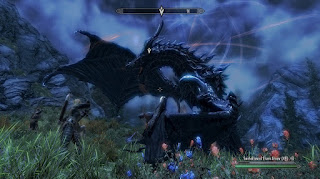
Taking place 200 years after Oblivion, players were faced with two major narratives in Skyrim. First, there was the Nord rebellion, as Ulfric Stormcloak and his forces were trying to free the region of Imperial rule. This left players with a choice: support the Stormcloak rebellion or help the Empire to quell it. Second, the player would discover that they’re something called the Dragonborn, a rare, legendary figure in Nord history that is born with the blood and soul of a dragon, but the body of a mortal. This leads to one learning more about the Dragonborn as players are educated in their gift and better learn to wield their new found powers. Ultimately, this leads to a confrontation with Alduin, an ancient dragon who has returned to destroy the world.
With Skyrim, we saw the game get three expansions: Dawnguard, Hearthfire, and Dragonborn. First, there was Dawnguard which was all about vampires giving players the choice of joining a particularly ancient family of these blood suckers and helping in their nefarious plans or becoming a vampire hunter and stopping said plans instead.
Next, we had Hearthfire, which was more of a mini expansion. In it, players were given the ability to build their own house instead of just decorating whatever lodgings that they had in the various keeps around Skyrim. These were much more customizable houses that could be big or small with all sorts of rooms to choose from. Players were also able to adopt up to two orphans in the expansion, giving them a home, and
becoming absentee parents as they went on adventures in this or that cave or ruin, only to return to their attention-starved child weeks later and giving them some bauble that they found, hoping it would be enough to smooth things over.
Finally, there was Dragonborn, the final expansion, where players would head to the dark elf island of Solstheim, which in many ways felt like a nostalgic trip back to Morrowind thanks to all of the Dunmer architecture and music from that game. Here players had to defeat Miraak, the first Dragonborn, now corrupted and bent on taking over the world.
With Skyrim, we saw more mods than ever before thanks to the implementation of hte Steam Workshop. With this, legions of mods were created that could do just about anything whether it was improving the graphics, adding new quests, new weapons, or entirely new areas of the world. The game has a seemingly bottomless pit of mods that are constantly breathing new life into Skyrim.
That being said, this feature was hit with a fair bit of controversy in 2015 when it became possible for people to charge money for their mods on Steam. This resulted in a huge backlash as many felt that mods should be free and the system itself wasn’t very well-implemented. Eventually, the decision was reversed and Skyrim’s mods returned to being free, but some damage had been done. The game got so many bad user reviews that it got pushed down significantly in the rankings for that metric, as players expressed their anger by down voting the game.
Ultimately, though, Skyrim is by far the most universally well-received entry in the Elder Scrolls series. Critics praised its visuals, exploration, quests, and gameplay, while fans to this day adore the game. It’s also sold far more copies than any other installment in the series, cracking the 20 million units mark. Even now, it’s still one of the most played games on Steam when checking the “current players” charts on the service, and continues to be a top seller whenever there is a Steam sale. At this point, Skyrim is for many the high point in the series.
ELDER SCROLLS ONLINE
In 2012, Zenimax got the idea to do something different with the Elder Scrolls and decided to make an MMORPG with the franchise. It was a risky move considering how many other companies had tried this and failed. Blizzard was still the dominant force here with World of Warcraft, but Zenimax seemed confident that their series was popular enough for it to work. Unfortunately, the game’s announcement was met with mixed to indifferent responses. Outside of diehard fans of the series, there was a lot of skepticism regarding Elder Scrolls Online.
The game was developed internally at Zenimax rather than by Bethesda. Taking place during the second era before the reign of Tiber Septim, it was a very different world than previous Elder Scrolls games, opening it up to explore a lot of relatively untouched lore. It gave players the chance to see first hand some of the things that they may have read about in the books they had found in previous games. It would also be possible to travel all across Tamriel, something that hadn’t been possible in an Elder Scrolls game for years.
By the time the game finally released, it had managed to peak enough people’s curiosity to sell reasonably well, which was impressive in a time when subscription based MMOs were a dying breed. However, the player base didn’t remain consistent with many letting their subscriptions expire. To address this, Zenimax eventually dropped the subscription all together, making it a buy to play game. This combined with console ports to the PlayStation 4 and Xbox One helped to ensure that ESO would do reasonably well as it eventually found a stable audience that is sticking around more now.
And with that, we end this look back at the Elder Scrolls. It’s been over 20 years since the first game was released, and the series is easily more popular than it has ever been. The big question now is where will the series go from here. They do have a collectible card game in the works with Elder Scrolls: Legends, but beyond that we just don’t know what the series will do next. Will we get an announcement for The Elder Scrolls VI soon? Only time will tell...


