Back in the days of the PlayStation 2 there was a much greater range in pricing of games. We had the obvious super high-end stuff that would go for $50 (boy do I miss those days as we continue to see prices rise first to $60 and now $70), and there was the lower end of the spectrum where quality would often become questionable as the price dipped lower and lower below the $30 mark for a new release. Then we had the mid-tier stuff. It would usually cost about $40 and people would go into them knowing that they weren't going to necessarily be on par with the games at the higher price point, but they also wouldn't be on a level of the cheaper, generally badly made games. They'd provide a solid experience, usually with some interesting quirks along the way.
Fairy Fencer F very reminds me of those days. It's by no means the best of JRPGs but neither is it a bad game. What we have is a reasonably priced title with an interesting battle system and straightforward, humorous story. Most people will likely get through it in about 25-30 hours feeling entertained, glad that they made some time for the game.
This is another in the growing tidal wave of Vita games that have been getting ported over to the PC over the last few years, and that's the version that I played. With that, one shouldn't expect too many fancy features in terms of settings. It's a down and dirty port, but gets the job done. People who absolutely insist on a vast array of graphic settings maybe be disappointed, but the keyboard controls are okay-ish, or at least not as god awful as some other ports of Japanese games to come along in recent years. I can't comment on them too much, though, as I stuck with an Xbox 360 controller for the majority of my playthrough.
From the get go it becomes apparent that the story is very traditional fair. In the distant past, a goddess and demon fought for control of the world, but in the end it was a stalemate as their attacks forced each other into suspended animation. This in mind, the game becomes a race between the forces of good who want to reawaken the goddess and the forces of evil who would like to bring back the demon. It doesn't get much more cliched than this. With that, we follow the adventures of Fang, a young, rather selfish lad, who accidentally gets swept up in all of this when he pulls a sword out of the ground, becoming it's owner and being teamed with a fairy, Eryn, that resides within it. This makes Fang into a Fencer, a person who wields a fairy-imbued weapon. There are all sorts of weapons like this scattered through the land and they can be used to release the goddess or demon, so Fang, Eryn, and a growing group of friends set out to find them all before the evil Dorfa Corporation can do the same for the vile god.
What makes the heavily trodden story palatable is the cast of characters, as their interactions can often be pretty funny. Pippin is by far my favorite of all the people I encountered with his self-important, yet friendly demeanor. Others had their moments too, like Glados' budding bro-mance for Fang, and Harley's overzealous desire to learn more about fairies. There are also a few moments of obnoxious fan service. I'm not a fan of that sort of stuff, so tend to get annoyed by it, but thankfully they're far and few between. It is also possible to recruit two optional characters into the party if certain conditions are met. They aren't necessary, but are fun additions to the group making them worthwhile to pursue.
While playing Fairy Fencer F, people familiar with some of Compile Hearts' other recent RPGs will notice a lot of similarities, especially if you've played some of the Neptunia games. Things bounce between a hub city where one picks up new quests, buys items at shops, and talks to locals, and a world map where one moves an icon around, selecting specific locations to visit. It's a stripped down method that very much limits opportunities to explore, but adds a certain amount of brevity to getting around. It is also possible to modify any given region if you use the correct fairy. This will change the types of monsters that spawn there, which becomes necessary when doing side quests handed out at the local tavern.
Battles while hunting these monsters (and pretty much everyone else) are the strong point of the game. Combat is turn-based on a fairly large field where enemies and your party can more around, trying to get into range of one another and unload with various attacks. There's the expected abilities like special attacks and spells which consume energy, but what is really fun is developing combos. These are actually cobbled together outside of combat in the game menu. For this, players assign different attacks to different buttons, many of which play into one another. Then, when combat begins, if you bring a character within attack range and begin, instead of simply doing a normal attack you can string it from one into the next, selecting what you want to do as you go. This is useful when trying to exploit an enemy's weakness. Since everyone in your party are Fencers, their weapons can actually morph on the fly from swords to scythes to bows to guns and so forth which plays into the combo system since you can then select which attack to do next and go with something that will do the most damage to enemies. Early on, there isn't much one can do with combos, but as you spend ability points to improve characters stats and unlock new abilities it becomes possible to add new strings of attacks to a combo.
As fancy as the combo system is, combat is actually quite easy much of the game. For the first 10 hours, battles were extremely easy as my party steamrolled everything in their path. After this, there was a mild difficulty spike but this was more a matter of fights taking longer than becoming insurmountable. I did wind up unlocking Apollonius, which required grinding up to level 40, and this can make some areas of the game easier as well, so that is something to keep in mind. The only area that came off as truly challenging was Shukesoo's Tower, which is optional content anyway. The ease of battles doesn't really take anything away from the game, as they're still enjoyable trying to find the best combos and spells to unload and see if you can outdo yourself with the amount of damage your group can dish out in a single turn. People expecting tough, unforgiving battles, though, just won't find that here.
The game isn't exactly a looker either. A lot of the areas, art, and backgrounds have a fairly standard anime-inspired look to them. Apparently Yoshitaka Amano and Nobou Uematsu contributed to the game, but I had trouble identifying where they may have had a hand in that. I'd have to imagine the former designed some of the monsters, as some of them looked quite unconventional. However, I'm still scratching my head trying to figure out which parts of the score may have been done by Uematsu. The music as a whole is decent, though the tunes that plays when characters Fairize (ie. take on a more powerful form) is pretty cheesy and gets stuck in my head more than I'd like.
Shortcomings aside, I still enjoyed going on this little adventure with Fang and the gang. Fairy Fencer F by no means tries to reinvent the wheel. It simply provides a fun story with some enjoyable characters and a good battle system. The game's publisher was also smart enough to give the game a price that reflects this, so I didn't feel at all out of pocket for the experience I had. People with a hankering for a pleasant, straightforward JRPG should give some serious consideration to this game.
Oh look, it's a video game blog. In an age rife with YouTube gamers something like this is almost quaint...
Showing posts with label ps vita. Show all posts
Sunday, 21 February 2016
Saturday, 16 January 2016
Read Only Memories: A Love Letter to Snatcher
While point-and-click adventures dominated PC gaming in much of the 80s and 90s, we largely saw a Western interpretation of the genre. Games of this ilk were a rarity in Japan, as RPGs were what folks tended to gravitate toward over there when they wanted a narrative heavy experience. That's not to say no adventure games ever came out over there, because they did, but they were a rarity by comparison, and developers' take on the genre was quite different. These games, while still having puzzles and whatnot to solve, were often much more focused on story and visuals with two of the most well-known games of this sort being Snatcher and Policenauts.
Both of these were created by Hideo Kojima before Metal Gear Solid became his primary focus in development, being heavily inspired by films like Blade Runner and The Terminator with their cyberpunk, film noire undertones. The games were a fascinating take on adventure games as they went about story, puzzles, and ambience in their own way. These days, they're largely viewed as classics, and only now are we seeing people put out a game that is very much an homage to them with Read Only Memories, a game that goes for this much more Japanese approach to adventure games.
Just like the games it's emulating, players set on a cyberpunk romp, exploring Neo San Francisco as they help a little robot named Turing figure out what happened to its creator, who also just so happens to be an old friend of the main character. All the while, visuals akin to late 8-bit and early 16-bit games fill the screen, and synth-heavy tunes stream from the speakers. It's something I'd expect to see on a Sega Genesis with a slightly more modern sensibility in terms of artistic style.
Playing through it, the game ticks a lot of the right boxes as a fan of Snatcher, although it does feel a tiny bit more like a visual novel than an adventure game. A lot of one's time is spent in conversation with people either chatting or trying to get information out of them. So, the most players have to worry about in these situation is the kind of persona that they want the main character to project, usually selecting from a nice guy answer, a dickish answer, and something in the middle. The answers do matter in that there are multiple endings to the game and they're impacted in part by what Turing thinks of you once it's over, making it something to keep in mind.
This isn't to say you'll spend your whole time talking to people, trying to solve a crime. There still are some puzzles to solve and other non-conversational activities, many of them quite novel. Nonetheless, that is what a majority of one's time will be spent doing, so have a cup of tea ready and settle in for some reading.
Thankfully, the story is good. Solving the mystery of Turing's missing creator takes a fair bit of sleuthing, and feels very noire while going about it. There isn't anything that is hugely novel about it, but a cast of charming characters with some nice plot twists keep things interesting. ROM does try to touch on some social issues, but it doesn't feel like the game is being preachy about it. If the player wants to sit down and have a good think about them, they can go down quite the rabbit hole, but that's on the individual, as the game doesn't dwell on the stuff, simply putting it out there as food for thought instead.
Fans of games like Snatcher and Policenauts should seriously think about giving Read Only Memories a shot. It really does a good job of revisiting the sorts of games these were, rare gems in their own time that didn't get the attention they deserved when they first came out. From recapturing the aesthetic to giving us a nice little cyberpunk story, the game will be most welcome to folks who miss this sort of adventure game even if it does lean a little bit more toward feeling like a visual novel.
Both of these were created by Hideo Kojima before Metal Gear Solid became his primary focus in development, being heavily inspired by films like Blade Runner and The Terminator with their cyberpunk, film noire undertones. The games were a fascinating take on adventure games as they went about story, puzzles, and ambience in their own way. These days, they're largely viewed as classics, and only now are we seeing people put out a game that is very much an homage to them with Read Only Memories, a game that goes for this much more Japanese approach to adventure games.
Just like the games it's emulating, players set on a cyberpunk romp, exploring Neo San Francisco as they help a little robot named Turing figure out what happened to its creator, who also just so happens to be an old friend of the main character. All the while, visuals akin to late 8-bit and early 16-bit games fill the screen, and synth-heavy tunes stream from the speakers. It's something I'd expect to see on a Sega Genesis with a slightly more modern sensibility in terms of artistic style.
Playing through it, the game ticks a lot of the right boxes as a fan of Snatcher, although it does feel a tiny bit more like a visual novel than an adventure game. A lot of one's time is spent in conversation with people either chatting or trying to get information out of them. So, the most players have to worry about in these situation is the kind of persona that they want the main character to project, usually selecting from a nice guy answer, a dickish answer, and something in the middle. The answers do matter in that there are multiple endings to the game and they're impacted in part by what Turing thinks of you once it's over, making it something to keep in mind.
This isn't to say you'll spend your whole time talking to people, trying to solve a crime. There still are some puzzles to solve and other non-conversational activities, many of them quite novel. Nonetheless, that is what a majority of one's time will be spent doing, so have a cup of tea ready and settle in for some reading.Thankfully, the story is good. Solving the mystery of Turing's missing creator takes a fair bit of sleuthing, and feels very noire while going about it. There isn't anything that is hugely novel about it, but a cast of charming characters with some nice plot twists keep things interesting. ROM does try to touch on some social issues, but it doesn't feel like the game is being preachy about it. If the player wants to sit down and have a good think about them, they can go down quite the rabbit hole, but that's on the individual, as the game doesn't dwell on the stuff, simply putting it out there as food for thought instead.
Fans of games like Snatcher and Policenauts should seriously think about giving Read Only Memories a shot. It really does a good job of revisiting the sorts of games these were, rare gems in their own time that didn't get the attention they deserved when they first came out. From recapturing the aesthetic to giving us a nice little cyberpunk story, the game will be most welcome to folks who miss this sort of adventure game even if it does lean a little bit more toward feeling like a visual novel.
Wednesday, 13 January 2016
PSO2 Anime: Best Unintentional Comedy of 2016?
As much as I adore Sega, there will forever be this small pit of animosity that I'll harbour toward the company for never releasing Phantasy Star Online 2 in the West. There's not even much point arguing it anymore, as it just isn't going to happen at this rate. If I want to play it, I'll need to just use the English patch and never be able to give Sega any money for it since the game doesn't accept foreign credit cards in-game.
So, imagine my surprise when I found out that an anime based on the game was in the works, and not only that but it would be getting simulcast on Crunchyroll. It really made me wonder if some part of the cosmos was mocking me, rubbing salt in my wounds knowing how much this would get on my nerves. Sega can't be bothered to bring PSO2 our way but screw it, they'll greenlight an animated series pretty much designed as a glorified advertisement for their game to be shown in the West. Up yours, Sega. Do you seriously think I'm going to watch this and open myself up to wave upon wave of heartache as this show constantly reminds me of a game that will never get an official localization?
Of course, I'm going to watch it. This is the sort of self hate that Phantasy Star fans routinely inflict on themselves. The first episode is up, so it's time to hop on board this train.
Not surprisingly, the show is quite bad. There's probably worse out there, but I don't usually go out of my way to find bad anime. PSO2 doesn't have any standout qualities to it. If anything, it feels like the show's main character, Itsuki Tachibana, is a metaphor the the show. He's touted as someone that is "just okay" at everything. He gets okay grades and helps out with lots of activities around the school in an "okay" manner. The guy isn't good or exemplary in anything, merely adequate. The anime is just like that with everything about it being "just okay." Even the soundtrack manages to be "just okay" which is flabbergasting when one considers how good the music in Phantasy Star games normally is.
Actually, there is one area in which PSO2 excels, and that's in how bad the story is. Obviously, one shouldn't go into this show expecting much. It's basically a 12-episode advertisement for an MMORPG. Nonetheless, the unabashed way in which this thing flogs the game is pretty embarrassing and I've seen porn with better mechanisms to justify advancing a plot point than some of the stuff PSO2 pulls.
In the first episode, it basically introduces the main characters, beats viewers over the head telling them how great PSO2 is, then somehow the student council decides to recruit Itsuki to fill in the role of vice president because the girl who usually occupies the that post is studying abroad for a year. Then the show informs us that his sole responsibility as vice president is to play PSO2 because apparently it's what the school is doing to test how good its Wi-Fi network is. Call me crazy, but there are probably much better ways of going about that.
With that, Itsuki installs the game on his PC and plays it for a bit where we see him get into a battle and meet a CAST player named Soro, formally introducing the game to viewers. After he'd finished, he had to write a report on his session for the student council and submit it. The president said, "Good job!" and earnestly reminded Itsuki to make sure he kept his grades up while working on this project.
Looking back, I don't think I've ever in my life cringed and laughed in such a way as I did. The whole thing was such a mix of brazen product flogging and bad writing that I'm pretty sure my brain shut down multiple times during the show as a defense mechanism to protect me from all of the stupid. The crazy thing is that we have eleven more episodes of this, and part of me is darn tempted to keep on going down this rabbit whole to see just how bad things gets. This really could be something amazing for all of the wrong reasons.
Labels:
anime reviews,
MMORPG,
pc gaming,
Phantasy Star Online 2,
ps vita,
Sega
Wednesday, 18 March 2015
Review: Söldner-X 2: Final Prototype (PS Vita)
Nothing like a good ole fashioned horizontal shoot-'em-up to take the rough edges off of a lousy day! Unless, of course, you suffer from an advanced case of obsessive compulsive disorder… then perhaps this may not be the preferred method to decompress.
Thursday, 29 May 2014
Review: Soul Sacrifice Delta (PS Vita)
Soul Sacrifice Delta isn't quite a sequel, yet it still feels like a fresh game. It improves upon many aspects that people disliked about the previous game, and adds a bevy of new content on top of it to encourage us to take another look through Librom's pages.
A major gripe with the first soul sacrifice was that of the difficulty curve. Delta mixes this up by rebalancing a lot of the offerings, as well as the damage and HP of earlier monsters. Going back to early quests makes you feel sufficiently powerful, while the late game pacts are incredibly challenging in some instances. Your most powerful offerings can also be upgraded into Black offerings, giving increased potency at the cost of fewer casts. This may not always be worth the trade-off, but some spells become more powerful than they ever were before.
Monday, 31 March 2014
Review: SteamWorld Dig (PS4, PS Vita)
The big push in indie gaming over the last few years has proven to me that I will always gravitate to functionality and game design over visual/auditory design. On the rare times that you get the entire bundle, it's a gem worth picking up. Steamworld Dig definitely fits well in both categories, being a well-designed and implemented game but still pretty to look at and appreciate.
You play the robot prospector Rusty who has been given his Uncle Joe's mine and trusty pick-axe (well, not so much given as picked up of his corpse… but that's neither here nor there).
Monday, 6 January 2014
Review: A-Men 2 (PS Vita)
A-Men 2 is a game that suffers from murky instructions, ho-hum graphics and a difficulty curve so steep you may as well just jump off a cliff. It’d be a whole other matter if the game gradually introduced mechanics in a clever and subtle way, which sadly is not something A-Men 2 does well.
Labels:
a-men 2,
bloober team,
lost vikings,
PlayStation 3,
ps vita,
psn,
Reviews,
video games
Thursday, 19 December 2013
Review: Y's: Memories of Celceta (PS Vita)
The Y's franchise never really got the traction in North America that it should have, which is really a shame for RPG fans like myself (who couldn't find a copy of the original games for decades). As a result, the fourth game in the franchise never was officially released in North America until now – and it's been updated to match modern sensibilities.
Wednesday, 18 December 2013
Review: Rainbow Moon (PS Vita)
Rainbow Moon is a PlayStation Store download title that first came out for the PlayStation 3 back in July of 2012 and is now available for the Vita.
The combat system uses a top down isometric-view battle area, akin to Final Fantasy Tactics. In an ideal world, the battles are a balancing act of using both position and well placed battle strategies to maximize your inflicted damage and protect your team. Typically though, the battles are an enemy dog pile where you try and keep your team afloat with judicious amounts of healing items.
Monday, 18 November 2013
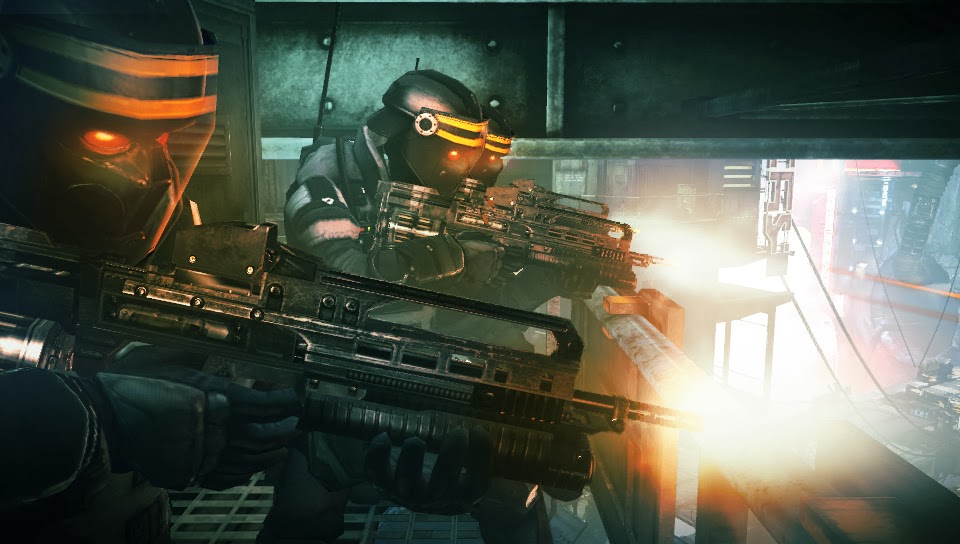
Review: Killzone - Mercenary (PS Vita)
The PS Vita was really aching for a good first person shooter, and while Killzone: Mercenary certainly has its faults, it’s easily the closest to filling this role and one of the best Vita games to date.
It’s a graphical behemoth that really showcases how beautiful Vita games can be, and while some silly mechanics like touch screen melee kills may turn off some people, they’re not forced. You can easily avoid melee combat with some tight gameplay that has that familiar weightiness that Killzone is known for.
Monday, 4 November 2013
Catching Up with Assault Android Cactus
Over the summer a fun little twin stick shooter called Assault Android
Cactus appeared on Steam's Early Access service. It features a team of female
androids out to stop hordes of robots from running a muck in various
locales, each girl with her own pair of unique primary and secondary
weapons. The game isn't really setting out to reinvent the genre in any
grand way, but it has some little tweaks to the gameplay and a very
nice aesthetic, making it a game to watch out for. I did a video on our YouTube channel discussing the game shortly after it became available,
but since that time there have been a few updates to it and I feel it's
high time I took a moment to revisit the game.
Wednesday, 11 September 2013
Review: Kickbeat (PS Vita)

Music rhythm games are one of those vices amongst some gamers – find an addictive enough game and you'll end up losing track of whole hours, if not days, at a time.
Most games in the genre use flying colors to keep you visually stimulated while you bang out the buttons on your controller or plastic instruments. Kickbeat has you wailing on hordes of enemies to the tune playing in the background. Mistakes normally would have an audio queue – either a screech in the music playback or a gap; instead mistakes are more tangible – your character gets hurt and takes damage. Too much damage and the game is over.
Sunday, 25 August 2013
Hands-on Preview: Killzone Mercenary (PS Vita)
The Vita is no stranger to shooters; however, their quality had left something to be desired. Both Call of Duty: Black Ops 2 Declasified and Resistance, two commercially successful franchises on the PlayStation 3 were both slammed by critics for being poorly made by nStigate Games.
Guerilla seeks to change that with Killzone: Mercenary.
Sunday, 27 January 2013
Review: Earth Defense Force 2017 Portable (PS Vita)
The original premise is practically out of B-movie heaven – the Earth is under attack from an alien force comprises of giant ants, spiders and assorted robots then use these hyper-destructive weapons to blow the crap out of EVERYTHING!
Friday, 5 October 2012
Feature: Sony Holiday 2012 Preview Event
Subscribe to:
Posts (Atom)