Back when the first Project X Zone came out, I was really looking forward to it. Having been a fan of Super Robot Taisen OG Saga Endless Frontier, I'd already gotten a taste of the juggling combat and the story was fun, so the prospect of a new game in that vein with the added bonus of a cavalcade of popular video game characters was quite enticing. Unfortunately, the original X Zone only delivered on half of this. The combat I knew and loved was there with some interesting tweaks. However, the story, that was a mess. When there are a lot of cameos in a game, movie, or whatever, the narrative can get really bogged down introducing everyone impacting the pace and diluting the story as a whole. A sizable chunk of the first X Zone felt like some drawn out version of the fight scenes from the Anchorman movies. Hours were spent introducing one character after the next with the story not going anywhere and after a time the whole thing got boring. Thankfully, with Project X Zone 2 this has been remedied since we have a lot of the same characters, so they already know each other, saving us a lot of time, and new characters are introduced a lot more quickly, as the developers seem to have learned their lesson from the last game.
With this game, the writers made a point of centering the plot more around one person, in this case Ryo from the Shenmue games. M. Bison and Saya are up to no good and part of their plan involves steeling a family heirloom from Ryo, so a short ways into the game he meets up with Chun Li and Xiaoyu who agree to help him out and before long he's joined the full group led by Reiji and Xiaomu as they muster a bigger and bigger force to deal with both the forces of Shadaloo and Ouma (not to mention any random evildoers they come across). Keeping the plot on track like this is much better than the first game and it's nice not having to spend so much time being introduced to all of the characters. That being said, story is still the weakest part of the game. It's not going to turn any heads, and it's only been elevated from paper thin to something on par with corrugated cardboard, but at least this time it manages to be entertaining. It should be said that this is a standalone story, so people who haven't played the first game can hope right in and won't feel lost here.
While the story itself is only so-so, one of the fun things to do is watching how the characters interact with one another. Since your little army is divided into smaller groups where you'll have a frontline assault force with a support unit attached for help, these people get along differently depending on who is matched with who. The things someone like Ryo will say while paired with Chun Li and Xiaoyu will be quite different than if you stick him with Morrigan and Demitri. Then there's Segata Sanshiro, who is fun to try matching with just about anyone.
Combat-wise, at this point I think one needs to be a fan of this type of battle system to enjoy it. If you've tried the previous game before or possibly OG Saga and didn't care for the combat, this game isn't suddenly going to change your mind. There are some minor changes to the combat here, but it's still all about the tactical elements as one places units on the map, then hopping into battles where the goal is to keep enemies airborne as much as possible, ideally only executing new attacks at the last possible moment in order to trigger critical hits. Doing this while calling in support units that trigger Cross Attacks where both groups are pummeling an enemy simultaneously is very satisfying. I'm a sucker for watching numbers flying by on-screen as a battle ensues with stuff flashing and fancy little animated scenes, so, for me, these battles are great.
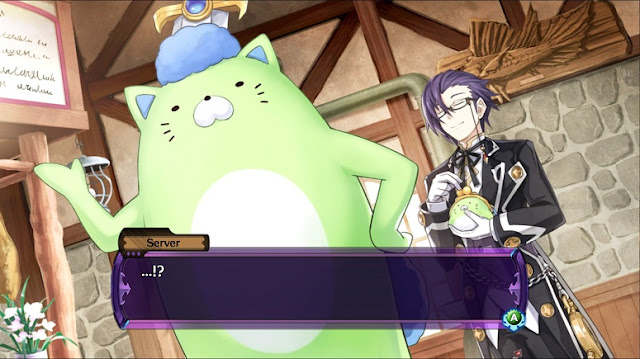
I've never been terribly enamored with the aesthetic of these games, though. They have a very functional approach with simplistic maps and character designs while slapping up some anime-styled character art when people are talking. It gets the job done but isn't anything special. However, there's something about the use of music in this game that really tugs at my heart strings. Whenever a unit is selected a theme from the game that the people are from plays and this really cranks up the nostalgia. On more than a few occasions I was really tempted to stop what I was doing so that I could fire up something like Streets of Rage or Strider because music from those games started to play.
At this point, Project X Zone 2 is what it is. The combat is interesting, but you'll need to have a taste for it. If you weren't fond of the combat in the first game, you won't enjoy it any more in this one. However, if you are craving a JRPG with a different sort of battle system, then this is one to consider. Now that the story is borderline tolerable, X Zone 2 makes for an enjoyable experience with a fun mix of popular game characters from a bunch of different series, this time managing not to get bogged down by introductions.
Oh look, it's a video game blog. In an age rife with YouTube gamers something like this is almost quaint...
Showing posts with label role-playing game. Show all posts
Monday, 29 February 2016
Sunday, 21 February 2016
Fairy Fencer F: A Surprisingly Good B Tier RPG
Back in the days of the PlayStation 2 there was a much greater range in pricing of games. We had the obvious super high-end stuff that would go for $50 (boy do I miss those days as we continue to see prices rise first to $60 and now $70), and there was the lower end of the spectrum where quality would often become questionable as the price dipped lower and lower below the $30 mark for a new release. Then we had the mid-tier stuff. It would usually cost about $40 and people would go into them knowing that they weren't going to necessarily be on par with the games at the higher price point, but they also wouldn't be on a level of the cheaper, generally badly made games. They'd provide a solid experience, usually with some interesting quirks along the way.
Fairy Fencer F very reminds me of those days. It's by no means the best of JRPGs but neither is it a bad game. What we have is a reasonably priced title with an interesting battle system and straightforward, humorous story. Most people will likely get through it in about 25-30 hours feeling entertained, glad that they made some time for the game.
This is another in the growing tidal wave of Vita games that have been getting ported over to the PC over the last few years, and that's the version that I played. With that, one shouldn't expect too many fancy features in terms of settings. It's a down and dirty port, but gets the job done. People who absolutely insist on a vast array of graphic settings maybe be disappointed, but the keyboard controls are okay-ish, or at least not as god awful as some other ports of Japanese games to come along in recent years. I can't comment on them too much, though, as I stuck with an Xbox 360 controller for the majority of my playthrough.
From the get go it becomes apparent that the story is very traditional fair. In the distant past, a goddess and demon fought for control of the world, but in the end it was a stalemate as their attacks forced each other into suspended animation. This in mind, the game becomes a race between the forces of good who want to reawaken the goddess and the forces of evil who would like to bring back the demon. It doesn't get much more cliched than this. With that, we follow the adventures of Fang, a young, rather selfish lad, who accidentally gets swept up in all of this when he pulls a sword out of the ground, becoming it's owner and being teamed with a fairy, Eryn, that resides within it. This makes Fang into a Fencer, a person who wields a fairy-imbued weapon. There are all sorts of weapons like this scattered through the land and they can be used to release the goddess or demon, so Fang, Eryn, and a growing group of friends set out to find them all before the evil Dorfa Corporation can do the same for the vile god.
What makes the heavily trodden story palatable is the cast of characters, as their interactions can often be pretty funny. Pippin is by far my favorite of all the people I encountered with his self-important, yet friendly demeanor. Others had their moments too, like Glados' budding bro-mance for Fang, and Harley's overzealous desire to learn more about fairies. There are also a few moments of obnoxious fan service. I'm not a fan of that sort of stuff, so tend to get annoyed by it, but thankfully they're far and few between. It is also possible to recruit two optional characters into the party if certain conditions are met. They aren't necessary, but are fun additions to the group making them worthwhile to pursue.
While playing Fairy Fencer F, people familiar with some of Compile Hearts' other recent RPGs will notice a lot of similarities, especially if you've played some of the Neptunia games. Things bounce between a hub city where one picks up new quests, buys items at shops, and talks to locals, and a world map where one moves an icon around, selecting specific locations to visit. It's a stripped down method that very much limits opportunities to explore, but adds a certain amount of brevity to getting around. It is also possible to modify any given region if you use the correct fairy. This will change the types of monsters that spawn there, which becomes necessary when doing side quests handed out at the local tavern.
Battles while hunting these monsters (and pretty much everyone else) are the strong point of the game. Combat is turn-based on a fairly large field where enemies and your party can more around, trying to get into range of one another and unload with various attacks. There's the expected abilities like special attacks and spells which consume energy, but what is really fun is developing combos. These are actually cobbled together outside of combat in the game menu. For this, players assign different attacks to different buttons, many of which play into one another. Then, when combat begins, if you bring a character within attack range and begin, instead of simply doing a normal attack you can string it from one into the next, selecting what you want to do as you go. This is useful when trying to exploit an enemy's weakness. Since everyone in your party are Fencers, their weapons can actually morph on the fly from swords to scythes to bows to guns and so forth which plays into the combo system since you can then select which attack to do next and go with something that will do the most damage to enemies. Early on, there isn't much one can do with combos, but as you spend ability points to improve characters stats and unlock new abilities it becomes possible to add new strings of attacks to a combo.
As fancy as the combo system is, combat is actually quite easy much of the game. For the first 10 hours, battles were extremely easy as my party steamrolled everything in their path. After this, there was a mild difficulty spike but this was more a matter of fights taking longer than becoming insurmountable. I did wind up unlocking Apollonius, which required grinding up to level 40, and this can make some areas of the game easier as well, so that is something to keep in mind. The only area that came off as truly challenging was Shukesoo's Tower, which is optional content anyway. The ease of battles doesn't really take anything away from the game, as they're still enjoyable trying to find the best combos and spells to unload and see if you can outdo yourself with the amount of damage your group can dish out in a single turn. People expecting tough, unforgiving battles, though, just won't find that here.
The game isn't exactly a looker either. A lot of the areas, art, and backgrounds have a fairly standard anime-inspired look to them. Apparently Yoshitaka Amano and Nobou Uematsu contributed to the game, but I had trouble identifying where they may have had a hand in that. I'd have to imagine the former designed some of the monsters, as some of them looked quite unconventional. However, I'm still scratching my head trying to figure out which parts of the score may have been done by Uematsu. The music as a whole is decent, though the tunes that plays when characters Fairize (ie. take on a more powerful form) is pretty cheesy and gets stuck in my head more than I'd like.
Shortcomings aside, I still enjoyed going on this little adventure with Fang and the gang. Fairy Fencer F by no means tries to reinvent the wheel. It simply provides a fun story with some enjoyable characters and a good battle system. The game's publisher was also smart enough to give the game a price that reflects this, so I didn't feel at all out of pocket for the experience I had. People with a hankering for a pleasant, straightforward JRPG should give some serious consideration to this game.
Fairy Fencer F very reminds me of those days. It's by no means the best of JRPGs but neither is it a bad game. What we have is a reasonably priced title with an interesting battle system and straightforward, humorous story. Most people will likely get through it in about 25-30 hours feeling entertained, glad that they made some time for the game.
This is another in the growing tidal wave of Vita games that have been getting ported over to the PC over the last few years, and that's the version that I played. With that, one shouldn't expect too many fancy features in terms of settings. It's a down and dirty port, but gets the job done. People who absolutely insist on a vast array of graphic settings maybe be disappointed, but the keyboard controls are okay-ish, or at least not as god awful as some other ports of Japanese games to come along in recent years. I can't comment on them too much, though, as I stuck with an Xbox 360 controller for the majority of my playthrough.
From the get go it becomes apparent that the story is very traditional fair. In the distant past, a goddess and demon fought for control of the world, but in the end it was a stalemate as their attacks forced each other into suspended animation. This in mind, the game becomes a race between the forces of good who want to reawaken the goddess and the forces of evil who would like to bring back the demon. It doesn't get much more cliched than this. With that, we follow the adventures of Fang, a young, rather selfish lad, who accidentally gets swept up in all of this when he pulls a sword out of the ground, becoming it's owner and being teamed with a fairy, Eryn, that resides within it. This makes Fang into a Fencer, a person who wields a fairy-imbued weapon. There are all sorts of weapons like this scattered through the land and they can be used to release the goddess or demon, so Fang, Eryn, and a growing group of friends set out to find them all before the evil Dorfa Corporation can do the same for the vile god.
What makes the heavily trodden story palatable is the cast of characters, as their interactions can often be pretty funny. Pippin is by far my favorite of all the people I encountered with his self-important, yet friendly demeanor. Others had their moments too, like Glados' budding bro-mance for Fang, and Harley's overzealous desire to learn more about fairies. There are also a few moments of obnoxious fan service. I'm not a fan of that sort of stuff, so tend to get annoyed by it, but thankfully they're far and few between. It is also possible to recruit two optional characters into the party if certain conditions are met. They aren't necessary, but are fun additions to the group making them worthwhile to pursue.
While playing Fairy Fencer F, people familiar with some of Compile Hearts' other recent RPGs will notice a lot of similarities, especially if you've played some of the Neptunia games. Things bounce between a hub city where one picks up new quests, buys items at shops, and talks to locals, and a world map where one moves an icon around, selecting specific locations to visit. It's a stripped down method that very much limits opportunities to explore, but adds a certain amount of brevity to getting around. It is also possible to modify any given region if you use the correct fairy. This will change the types of monsters that spawn there, which becomes necessary when doing side quests handed out at the local tavern.
Battles while hunting these monsters (and pretty much everyone else) are the strong point of the game. Combat is turn-based on a fairly large field where enemies and your party can more around, trying to get into range of one another and unload with various attacks. There's the expected abilities like special attacks and spells which consume energy, but what is really fun is developing combos. These are actually cobbled together outside of combat in the game menu. For this, players assign different attacks to different buttons, many of which play into one another. Then, when combat begins, if you bring a character within attack range and begin, instead of simply doing a normal attack you can string it from one into the next, selecting what you want to do as you go. This is useful when trying to exploit an enemy's weakness. Since everyone in your party are Fencers, their weapons can actually morph on the fly from swords to scythes to bows to guns and so forth which plays into the combo system since you can then select which attack to do next and go with something that will do the most damage to enemies. Early on, there isn't much one can do with combos, but as you spend ability points to improve characters stats and unlock new abilities it becomes possible to add new strings of attacks to a combo.
As fancy as the combo system is, combat is actually quite easy much of the game. For the first 10 hours, battles were extremely easy as my party steamrolled everything in their path. After this, there was a mild difficulty spike but this was more a matter of fights taking longer than becoming insurmountable. I did wind up unlocking Apollonius, which required grinding up to level 40, and this can make some areas of the game easier as well, so that is something to keep in mind. The only area that came off as truly challenging was Shukesoo's Tower, which is optional content anyway. The ease of battles doesn't really take anything away from the game, as they're still enjoyable trying to find the best combos and spells to unload and see if you can outdo yourself with the amount of damage your group can dish out in a single turn. People expecting tough, unforgiving battles, though, just won't find that here.
The game isn't exactly a looker either. A lot of the areas, art, and backgrounds have a fairly standard anime-inspired look to them. Apparently Yoshitaka Amano and Nobou Uematsu contributed to the game, but I had trouble identifying where they may have had a hand in that. I'd have to imagine the former designed some of the monsters, as some of them looked quite unconventional. However, I'm still scratching my head trying to figure out which parts of the score may have been done by Uematsu. The music as a whole is decent, though the tunes that plays when characters Fairize (ie. take on a more powerful form) is pretty cheesy and gets stuck in my head more than I'd like.
Shortcomings aside, I still enjoyed going on this little adventure with Fang and the gang. Fairy Fencer F by no means tries to reinvent the wheel. It simply provides a fun story with some enjoyable characters and a good battle system. The game's publisher was also smart enough to give the game a price that reflects this, so I didn't feel at all out of pocket for the experience I had. People with a hankering for a pleasant, straightforward JRPG should give some serious consideration to this game.
Labels:
Compile Heart,
Fairy Fencer F,
jrpg,
nis america,
pc games,
ps vita,
role-playing game,
Steam
Friday, 23 May 2014
Review: Dark Souls II (360)
Dark Souls came along and the gaming universe declared it, "Good."
As a gamer that has too many games on the go at any moment, I couldn't find time in my schedule to tackle a game that would politely be described as bloody hard. While I am familiar with the original from hearsay, I didn't play any of it. From the time that I've put into Dark Souls II, I can wholeheartedly agree with the assessment of the previous game: Dark Souls II is infuriatingly hard.
Most games will have their difficulty established by asking the gamer to accomplish a nearly flawless series of commands, or use a weak control structure to unfairly limit the gamer against an unencumbered opponent. Dark Souls II does neither, it gives you the tools to succeed right from the beginning, but does so little hand-holding that you are thrown into the deep end and expected to swim. With such a brutal difficulty curve, I found the praise to be a little surprising.
As a gamer that has too many games on the go at any moment, I couldn't find time in my schedule to tackle a game that would politely be described as bloody hard. While I am familiar with the original from hearsay, I didn't play any of it. From the time that I've put into Dark Souls II, I can wholeheartedly agree with the assessment of the previous game: Dark Souls II is infuriatingly hard.
Most games will have their difficulty established by asking the gamer to accomplish a nearly flawless series of commands, or use a weak control structure to unfairly limit the gamer against an unencumbered opponent. Dark Souls II does neither, it gives you the tools to succeed right from the beginning, but does so little hand-holding that you are thrown into the deep end and expected to swim. With such a brutal difficulty curve, I found the praise to be a little surprising.
Tuesday, 13 August 2013
Review: Dragon's Crown (PS3)
Dragon's Crown is a throw-back game that borrows heavily from side scrolling beat-'em-ups. The end result is a modernized interpretation of a classic genre.
Side-scrolling fighting games were a dime-a-dozen back in the stand-up arcade era and Dragon's Crown takes queues from the best of them. Beautifully rendered fantasy theme akin to Golden Axe, growth and development through looting and buying of upgrades (River City Ransom), elegant yet simple combat system (Final Fight), and most importantly the use of multiple players on screen (Double Dragon, Captain Commando).
Tuesday, 2 July 2013
Review: Knights of Pen and Paper +1 Edition (PC)
Sometimes tablet games translate well to the PC, other times not so much. Even if the game was fun and well received on the former, the way games are consumed on each of these platforms can be quite different so that what may be enjoyable on a tablet may not be so elsewhere. This is exactly what we have with the PC version of Knights of Pen and Paper. I can totally see how people would enjoy this game on a tablet, bonking some monsters on the head while on the train for 20 minutes. Even the above average level of control that players have over battles can seem intriguing in short bursts. However, most people who play RPGs on their home computers, myself included, tend to do so for fairly prolonged sessions. What was once a nice time waster here and there becomes a tedious slog. Even the once charming retro aesthetic begins to wear its welcome after half an hour or so.
Friday, 18 January 2013
Review: Baldur's Gate: Enhanced Edition (PC)
Forgotten Realms.
“It's so commercial,” he said with some bemusement.
I replied to him, “I blame Baldur's Gate.” And it's true.
Tuesday, 4 December 2012
Review: Mass Effect 3 (Wii U)
Being an Edmontonian, I have a special place in my heart for BioWare. I love the crap out of the Mass Effect franchise and Knights of the Old Republic, but there's also a bit of "home town" pride thrown in there as well.
The Mass Effect games, while not perfect, were some of the most entertaining games of the past 5 years in my mind. New consoles need strong launch titles, and while I agree that Mass Effect 3 is a strong title it's the final part of the trilogy and you're starting off with a pretty significant story handicap. As anyone who has played these games knows, this franchise is all about choices and their consequences (whether they are intentional or not).
Subscribe to:
Posts (Atom)


